
Improve your home’s thermal efficiency by insulating underfloor areas to reduce unwanted heat loss and cold drafts. This simple upgrade helps maintain a more comfortable indoor temperature throughout the year.Ideal for both retrofit and renovation projects in Manchester, underfloor insulation can significantly lower heating costs while improving overall energy performance and EPC ratings.
Uninsulated ground floors can contribute significantly to heat loss, particularly in older homes with suspended timber floors. Professionally installed insulation can reduce unwanted heat loss and improve comfort.
Cold air often enters your home through hidden gaps in suspended timber floors. Over time, these draughts make rooms feel colder, less comfortable, and harder to heat. Our underfloor insulation helps seal these gaps and creates a continuous thermal barrier, stopping unwanted air leakage and improving overall warmth throughout your home. This is especially effective in older UK properties where suspended timber floors are common.
A significant amount of heat in homes is lost through uninsulated or poorly insulated floors. By installing proper underfloor insulation, you can dramatically reduce heat loss and improve your home’s energy efficiency. This means your heating system doesn’t need to work as hard to maintain a comfortable temperature, helping you save approximately £100–£200 per year on energy bills, depending on your property size and usage patterns.
Through government-backed energy efficiency schemes, many homeowners may qualify for fully funded underfloor insulation. If eligible, the ECO4 scheme can cover the entire cost of installation, making it possible to improve your home’s comfort and efficiency at no upfront expense. This support is designed to help reduce fuel poverty, improve EPC ratings, and make UK homes more energy efficient. Eligibility is based on household income, benefits, and property energy performance.
Cold floors often contribute to condensation build-up, especially in ground floor rooms. Over time, this can lead to damp patches, mould growth, and unpleasant indoor conditions that affect both comfort and air quality. By insulating beneath your floors, you help maintain a warmer internal surface temperature, reducing moisture formation and lowering the risk of damp-related issues. This creates a healthier living environment for you and your family.

Underfloor insulation is ideal for homes with suspended timber floors, typically found in pre-1970s properties. These floors have a ventilated void underneath, allowing insulation to be fitted either from below (cellar/crawl space) or by lifting floorboards. This is common in Victorian terraces, 1930s semis, and many older Manchester homes.
Solid concrete floors are not suitable for this type of insulation and require a different solution, such as solid floor insulation. Properties with existing damp problems should have these issues resolved first to prevent trapping moisture. Very shallow floor voids (less than 150mm) may not allow enough space for proper installation. Likewise, floors affected by active woodworm or timber rot must be treated before insulation work can begin to ensure long-term performance and safety.
This is the most common method, where insulation such as mineral wool or sheep’s wool is fitted between timber joists and supported with breathable netting or mesh. It provides strong thermal performance and is suitable for most suspended timber floors with adequate access.
Rigid PIR insulation boards are precisely cut and fitted between joists, offering high thermal efficiency in a compact form. This method is ideal where floor depth is limited and no netting is required, giving a clean and durable finish.
In cases where access is available from below, insulation can be fixed beneath the joists. This method is commonly used in properties with cellars or crawl spaces and is effective when floor height above is restricted.
EPS (expanded polystyrene) beads are blown into the floor void through small access points. This low-disruption method is ideal for irregular or hard-to-reach cavities and ensures even coverage without lifting floorboards.
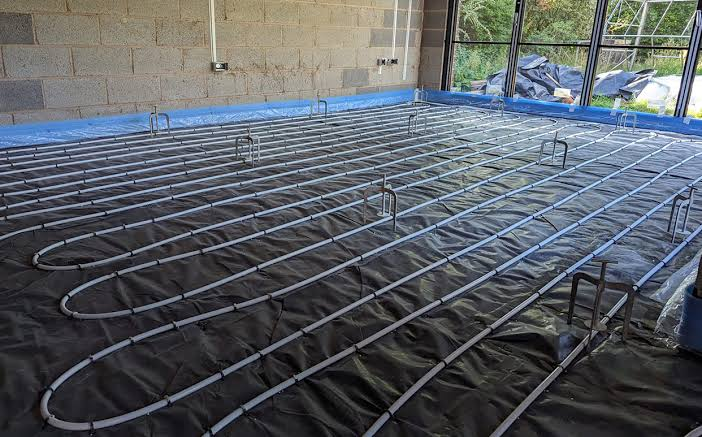
We use a range of high-performance insulation materials for underfloor insulation in Manchester, carefully selected based on floor type, void depth, ventilation conditions, and thermal performance requirements. Every material is chosen to improve energy efficiency, reduce heat loss, and prevent draughts in suspended timber floor systems commonly found in older homes.
Each installation is tailored to the property to ensure compliance with UK Building Regulations and best-practice retrofit standards, while maintaining proper subfloor ventilation to avoid condensation and damp issues.
All materials are installed according to the specific requirements of the property to ensure long-term thermal performance, moisture control, and durability, while maintaining airflow beneath the floor structure where required.

Proper underfloor ventilation is essential to keep suspended timber floors dry and structurally sound after insulation is installed. Without adequate airflow, moisture can become trapped in the floor void, leading to long-term damage.
Good ventilation helps prevent condensation forming on timber joists and floorboards, which can otherwise lead to decay over time. It also reduces the risk of woodworm and fungal growth, both of which can weaken the structure. In addition, proper airflow helps stop damp from rising into ground floor rooms, maintaining a healthier indoor environment.
Air bricks must always remain clear and unobstructed to allow continuous airflow beneath the floor. A minimum ventilation level of around 1500mm² per metre run of external wall is typically required to ensure adequate air movement. Cross-ventilation is essential, meaning air must flow between opposite walls for effective circulation. Insulation must be carefully installed so it does not block airflow at the edges of the floor void.
We take special care to maintain correct ventilation paths around the entire perimeter of the floor void. This ensures your insulation performs efficiently while protecting your home from moisture-related issues such as damp, rot, and structural deterioration.

We assess floor construction, void depth, ventilation, and any damp issues.
The cost of underfloor insulation in Manchester varies depending on property size, access to the floor void, and the condition of existing timber floors. Homes with easier access and standard joist spacing are usually quicker and more cost-effective to insulate, while larger or more complex properties may require additional labour and materials.
Typically costs between £800–£1,500. Many terraced homes have suspended timber floors that are straightforward to insulate, especially when access is available from below or via lifted floorboards. Under ECO4 funding, eligible households may receive partial or full support depending on assessment, energy efficiency rating, and scheme approval.
Usually ranges from £1,000–£2,000. Semi-detached homes often have larger floor areas, which increases material and installation time. ECO4 grants may cover up to 100% of the cost for qualifying households, significantly reducing or eliminating upfront expenses.
Generally cost between £1,500–£3,000 due to larger floor space and more complex layouts. Despite higher initial costs, detached properties often see greater long-term energy savings. ECO4 funding may also be available and can cover up to 100% of installation costs, subject to eligibility and survey results.
Overall, final pricing is confirmed after a property survey, which assesses floor type, access conditions, and insulation requirements.
ECO4 support depends on household income, EPC rating, benefits status, and property suitability following a technical survey.
| Property Type | Typical Areas in Manchester | Estimated Cost | ECO4 Funding Support |
|---|---|---|---|
| Terraced House | Levenshulme, Burnage | £800 – £1,500 | May cover part or up to 100% (subject to eligibility & survey) |
| Semi-Detached | Stockport, Oldham | £1,000 – £2,000 | Up to 100% funding available for eligible homes |
| Detached House | Bramhall, Didsbury | £1,500 – £3,000 | Up to 100% funding available depending on assessment |
At Compliant Retrofits, we specialise in underfloor insulation across Manchester, helping homeowners reduce heat loss, improve indoor comfort, and cut energy bills in older properties with suspended timber floors. Our solutions are tailored to each home, ensuring the right method is used for maximum efficiency and long-term performance.
Our experienced team carefully manages ventilation to prevent condensation, damp, and timber decay, ensuring your property remains safe and structurally sound after installation. We use proven insulation techniques designed specifically for UK housing stock, especially older Victorian and 1930s homes common in the Manchester area.
We also provide full support with ECO4 grant applications, including eligibility assessments, paperwork, and approval guidance, making the process simple and stress-free for homeowners. Where funding is available, we help you access fully or partially funded insulation upgrades.
All installations are carried out using high-quality, certified materials installed to industry standards. We take care to minimise disruption by carefully lifting and reinstating floorboards, ensuring your home is left clean, secure, and properly finished.
From your initial consultation through to final completion, we offer a fully managed service focused on quality, compliance, and long-term energy efficiency improvements you can rely on.

A: 130-200mm including insulation (80-120mm) and screed (50-75mm). Check your door thresholds and ceiling height before installation.
A: Above-slab insulation requires removing floor finishes (tiles, laminate, carpet). We can work around fixed furniture (kitchen units, island), but some disruption is unavoidable.
A: Yes, if you receive qualifying benefits or meet ECO4 Flex criteria. Contact us for a free eligibility check.
A: Yes, if you receive qualifying benefits or meet ECO4 Flex criteria. Contact us for a free eligibility check.